The hardest part of macro research isn't finding information. It's having too much of it.
Every morning the same barrage: Bloomberg alerts, sell-side notes, Twitter threads, WeChat pushes. The Fed hawked. Oil plunged. The ECB held but the vote split. Each signal looks like a thesis in isolation — but stitched together, it's just noise. Twenty minutes of scanning, and you close your phone less certain about what the market is actually trading.
Real opportunities live inside a handful of evolving narratives. The problem is that no one piece of news tells you which ones. You need to watch the same story unfold across days and weeks, tracking what changed at the margin — and what stayed the same.
Sembr launched as an open-source semantic radar in May. You write a natural-language intent, and it continuously scans 87+ news sources, matches articles by meaning (not keywords), and sends LLM-written briefings to your inbox. In v1.1, we added stateful memory — so the engine stops reporting "what happened today" and starts reporting "what changed since yesterday."
But the output lived inside email and a private dashboard — daily updates, no timeline, no 30-day summary, and a UI that worked for us but not for anyone else. We wanted to show what Sembr's narrative engine can actually do.
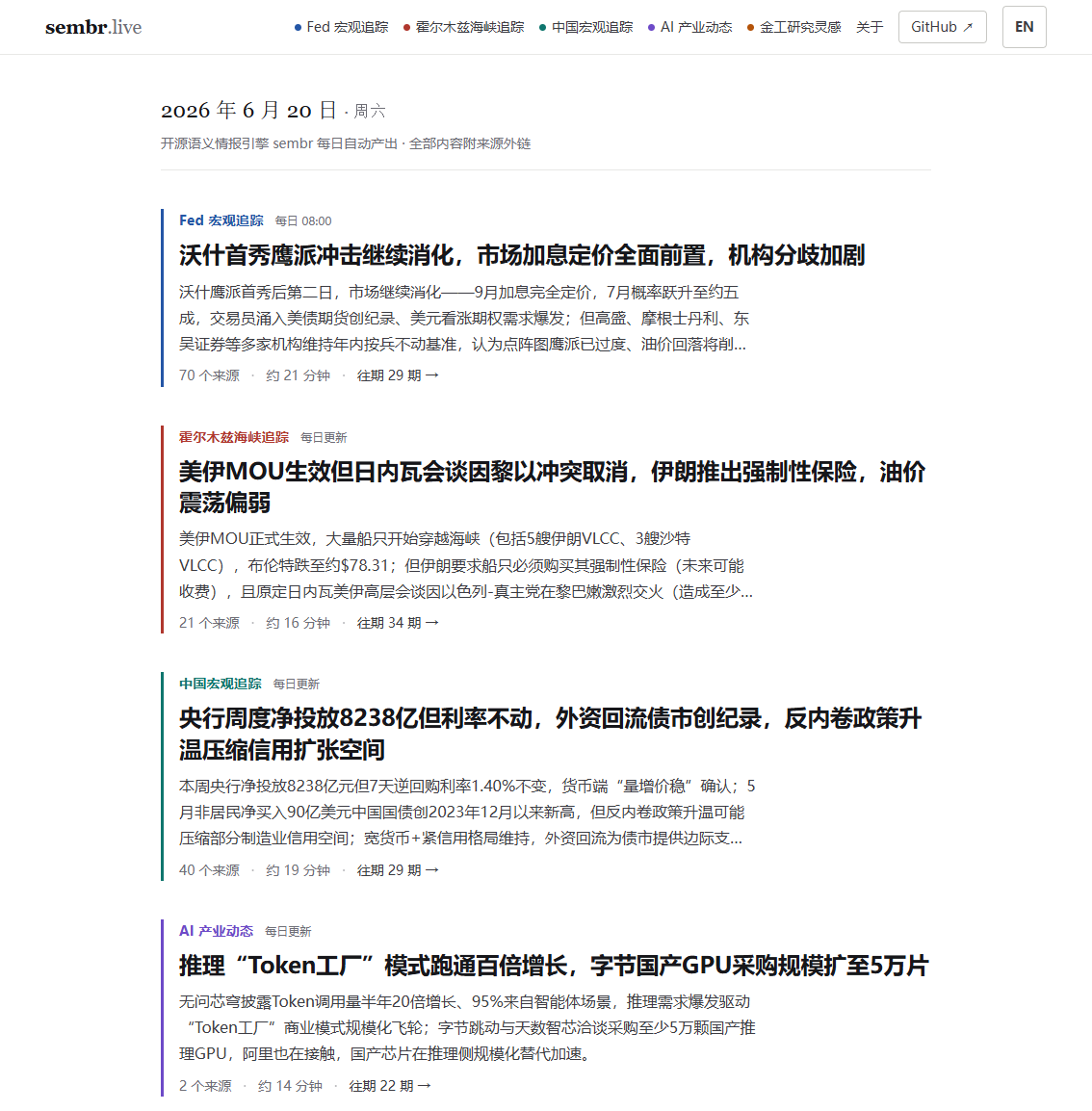
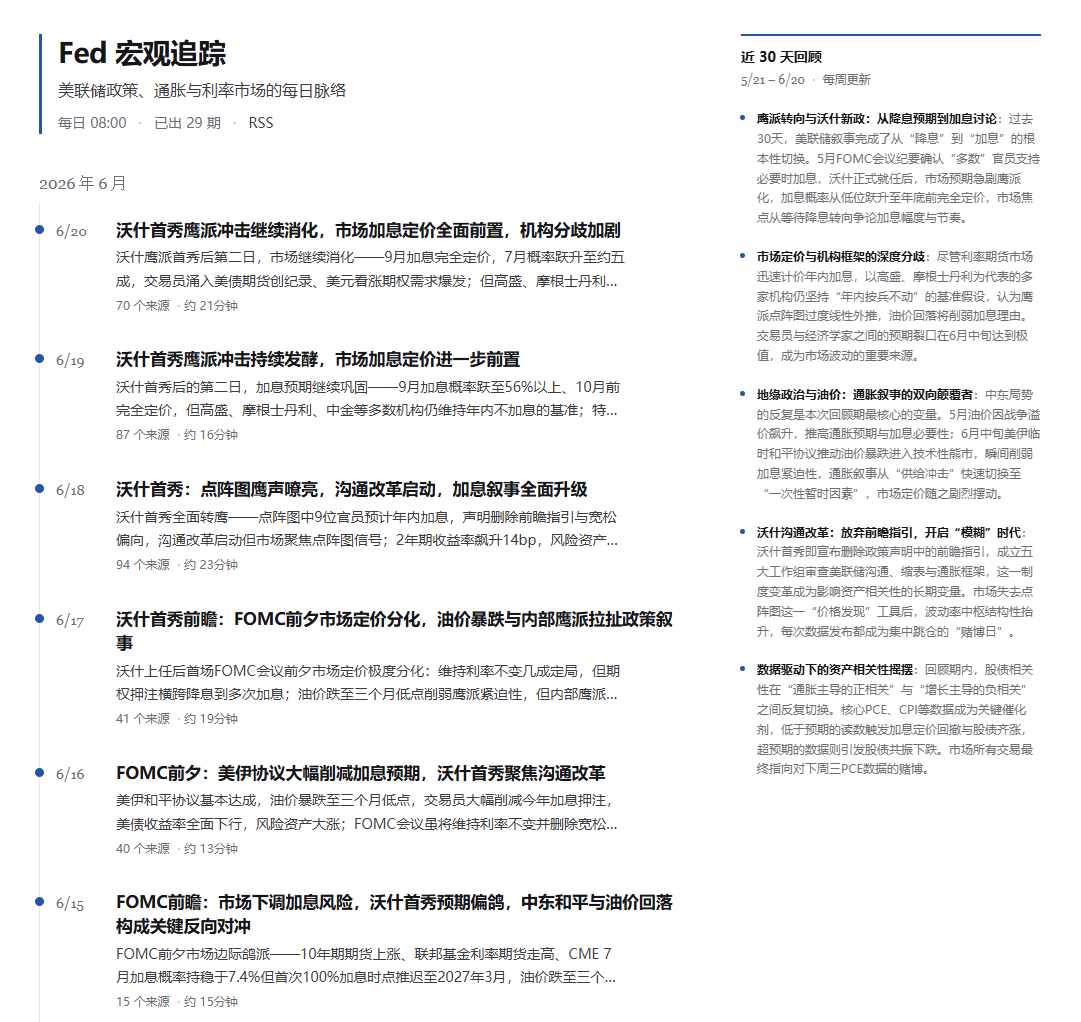
So we built sembr.live — a public demo site where Sembr's output is presented as a proper research interface. Daily briefings on the left. A rolling 30-day retrospective on the right. Five series in total, each with its own template and analytical depth. The full set runs on the Chinese-language site; English editions are now live for two series — Fed Macro Tracker and Hormuz Strait Watch — with more on the way.
What's Live
Fed Macro Tracker
Fed policy, inflation, and rates — daily pulse on the world's most important central bank.
Hormuz Strait Watch
Continuous narrative on the geopolitical crisis, from diplomatic breakthroughs to military escalation.
China Macro Tracker
Credit, fiscal, monetary policy, and the property sector — the other half of the global macro pair.
AI Industry Pulse
Foundation model shifts, funding rounds, compute race, and commercialization — what's moving the AI landscape.
Quant Research Ideas
Factors, strategies, timing signals, and reusable research threads from sell-side quant desks.
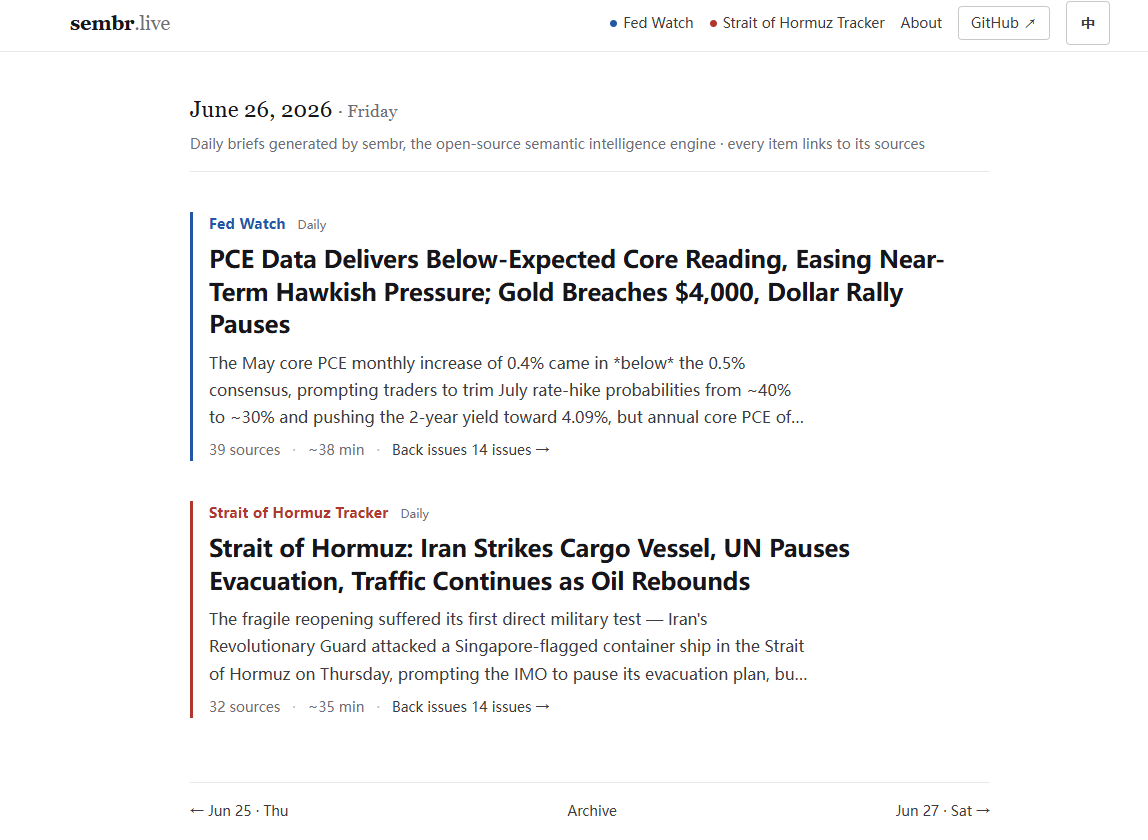
English editions currently live: Fed Macro Tracker and Hormuz Strait Watch. The remaining three series are available on the Chinese-language site — English editions coming soon.
30 Days of Noise, 5 Themes
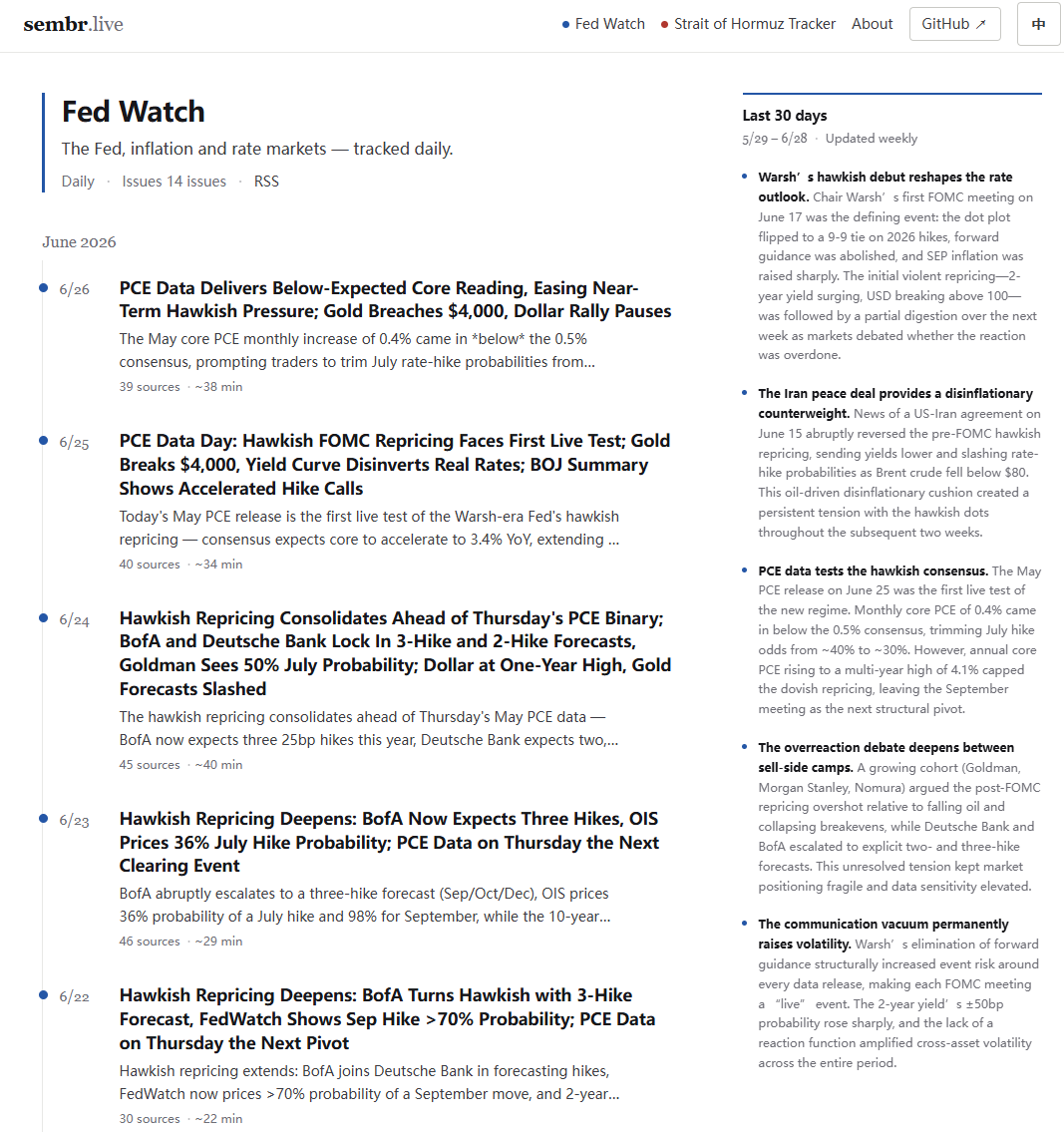
Every series page has two halves: a reverse-chronological feed of daily briefings on the left, and a "Last 30 Days" sidebar on the right. The sidebar is where Sembr's stateful memory does the heavy lifting — it reads 30 days of daily output, compares each day's delta, and synthesizes the persistent themes.
Here's what the Fed Macro Tracker's sidebar currently shows (data as of June 19):
- Hawkish Pivot The Fed narrative flipped from rate cuts to rate hikes in under 30 days. After the May FOMC minutes confirmed a "majority" open to tightening, Warsh's arrival drove hike probability from low single digits to fully priced by year-end.
- Markets vs. Institutions Fed funds futures moved to price hikes aggressively — but Goldman, Morgan Stanley, and others held their "on hold" baseline, arguing the dot plot over-extrapolates and falling oil prices weaken the case for tightening. The divergence between traders and economists peaked in mid-June.
- Geopolitics & Oil: The Two-Way Shocker May: war premium drove crude higher, tightening the inflation → rate-hike channel. Mid-June: a US-Iran provisional agreement sent oil into a technical bear market, instantly flipping the inflation narrative from "supply shock" to "transitory factor." Market pricing whipsawed.
- Communication Reform: Entering the "Opaque" Era Warsh's debut removed forward guidance from the policy statement and launched five working groups to review Fed communications, balance-sheet runoff, and the inflation framework. Without the dot plot as an anchoring tool, volatility structurally moves higher — every data release becomes a concentrated repricing event.
- Data-Driven Correlation Swings Stock-bond correlation flipped between "inflation-driven positive" and "growth-driven negative" regimes. Core PCE and CPI prints became the catalysts: below-consensus = rate-hike repricing pulls back + equities rally; above-consensus = synchronized selloff.
These five themes aren't a single day's summary. They're the product of Sembr's stateful memory reading 28 daily briefings, from 87+ sources, and identifying which narrative threads persisted — and which ones died after one headline.
The value proposition isn't "here's what happened today." It's: here's what the market has been trading for the last 30 days.
A Fixed Analytical Framework (That You Can Critique)
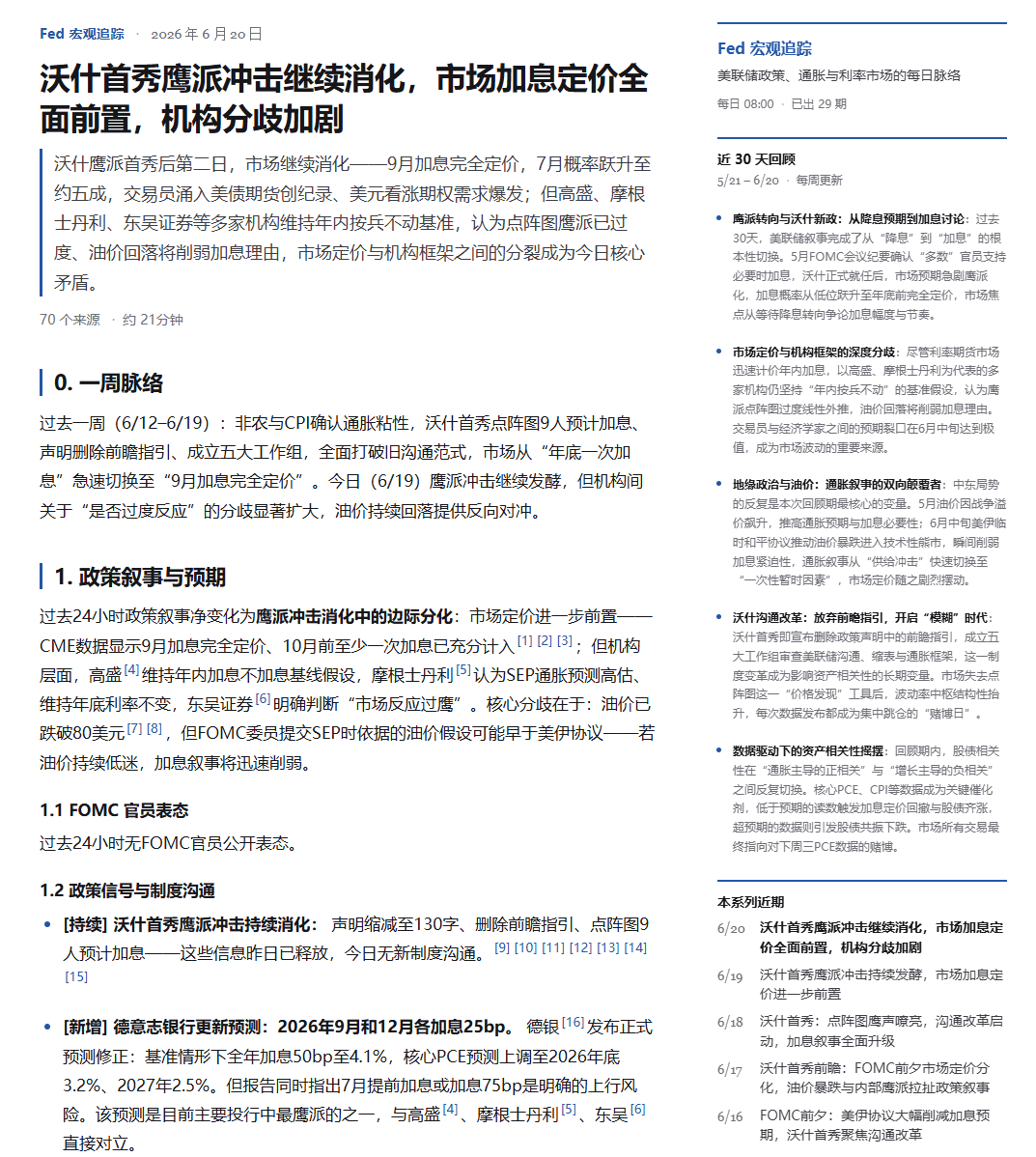
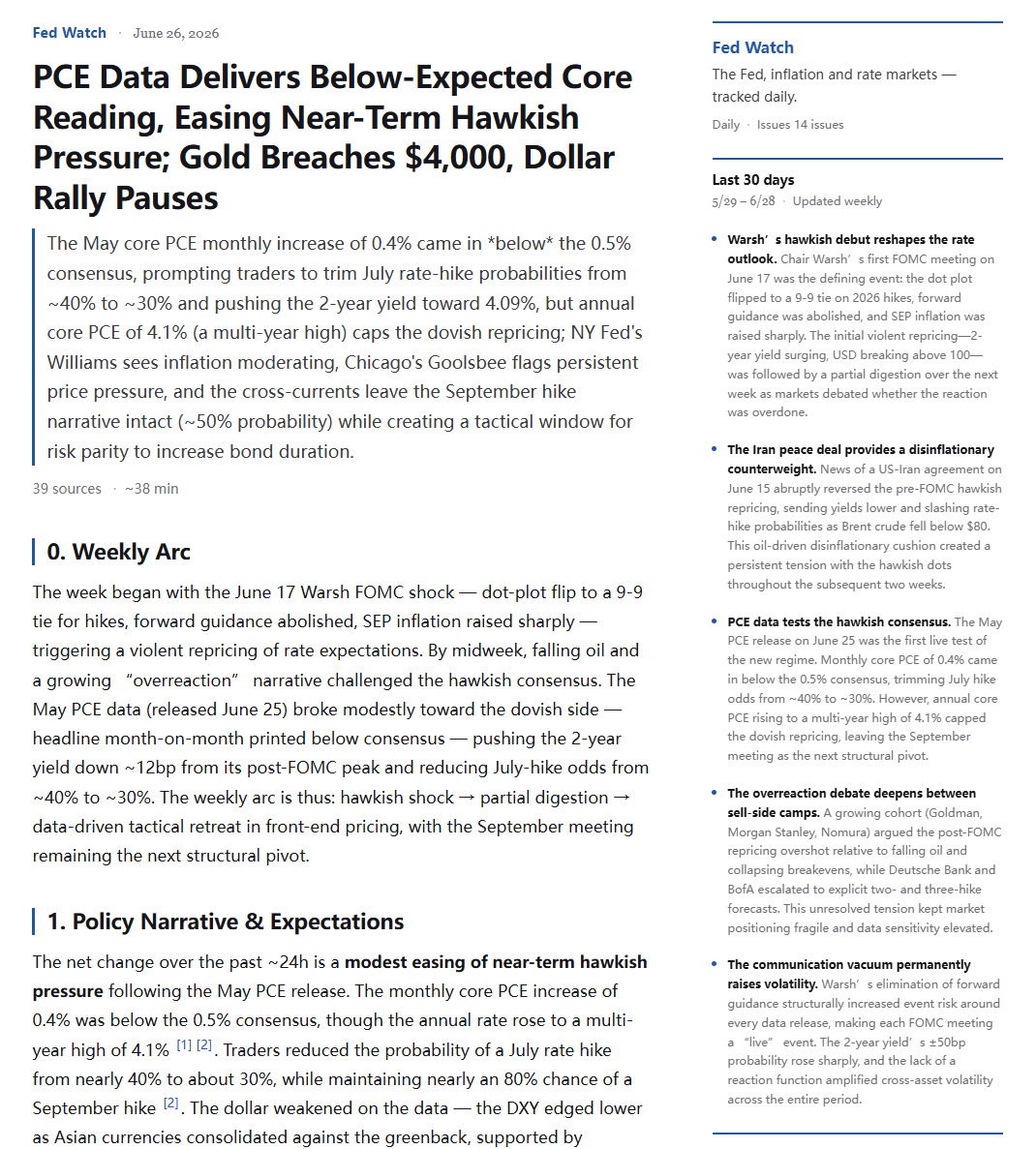
Click into any daily briefing and you'll see the same structure every time:
Weekly Thread
Past 7 days woven into one coherent arc.
Policy Narrative & Expectations
Quantify marginal shifts in policy stance.
Key Data & Market Interpretation
How new data changed the narrative.
Financial Conditions
Rates, FX, liquidity, commodities — the transmission signals.
Global Central Bank Linkages
Non-US monetary policy spillovers.
Asset Implications
Four-quadrant table + stock-bond correlation direction + risk budget read.
Counter-Consensus & Tail Risks
Consensus fragilities, second-order transmission, source quality flags.
This template serves two purposes. For humans: you always know section 5 has the asset impact, section 6 has tail risks — two minutes to locate what you need, no mental re-parsing required. For AI agents: the same fields produced daily mean cross-date comparison, backtesting a field's predictive power against asset returns, and feeding downstream agents for risk-budget adjustments — exactly the Layer 2 capability described in our infrastructure series.
But a template is also a ceiling. Dimensions you leave out get systematically missed. The framework is public precisely so readers can flag what's missing — open an issue on GitHub if you spot a blind spot.
More Than Macro: The Other Series
Fed Macro Tracker is the most mature series and the one we used to illustrate the 30-day capability — but Sembr Live isn't a one-trick pony. Each series has its own template because different topics demand different analytical structures:
- Hormuz Strait Watch is the same stateful memory engine applied to geopolitics — the v1.1 launch post demonstrated how three days of emails went from "major breakthrough" to "facing collapse" on the same story. A stateless LLM can't see the trend; stateful memory stitches the timeline.
- China Macro Tracker covers credit expansion, fiscal policy, monetary operations, the property chain, and FX — paired with the Fed tracker, you get a "dual central bank" narrative pair.
- AI Industry Pulse tracks the AI sector's evolving contradictions. A recent edition captured the tension: SiliconFlow closed a ¥2B+ Series B, validating the "token factory" capital-intensification thesis — but on the same day, Reuters cited Stanford research showing small LMs matching large models on 80% of tasks, challenging the trillion-dollar IPO valuation logic for frontier labs. Two parallel threads, no forced resolution.
- Quant Research Ideas is exactly what it sounds like — factor ideas, strategy sketches, timing signals, and reusable research snippets from sell-side quant desks. It won't tell you what to buy. It will tell you what the quant community is talking about this week.
Input Layer: Still Expanding
The source graph underneath Sembr Live now covers 87+ feeds: Bloomberg, Reuters, WSJ, CNBC, Twitter, and a growing set of Chinese-language sources. Two recent additions fill specific gaps: Chinese sell-side research (macro, strategy, and quant team notes) ingested via wechat2rss, and global institutional research from Goldman, Morgan Stanley, UBS, Barclays, and others.
Expanding the input layer isn't a "more is better" argument. It's a resolution argument: when the output layer is already producing stable narratives, every new class of high-quality source increases narrative resolution. But more sources also mean more surface area for hallucination drift — we're currently splitting the pipeline into a map-reduce architecture (structured fact extraction first, synthesis second) to tighten this.
The Stack
Sembr Live surfaces five series (two with English editions so far), but underneath it's the same three-layer architecture:
- Input layer keeps expanding — more sources, more languages, more signal types.
- Memory layer converts discrete information into continuous narrative — stateful, timeline-aware, delta-comparing.
- Output layer applies fixed analytical frameworks to turn narrative into decision-support that's fast to consume and structured for downstream automation.
This is the Layer 2 we've been describing: not replacing your trade decisions, but making sure your cognitive bandwidth is spent where the marginal return is highest — at the point where you decide, not at the point where you read.
Try It
Live site: sembr.live — start with Fed Macro Tracker, check the 5 themes in the 30-day sidebar, then click into a briefing.
GitHub: github.com/Peakstone-Labs/sembr — star the repo, self-host your own instance, or open an issue to tell us what analysis dimensions we're missing.
English series now live: Fed Macro · Hormuz Strait
Sembr Live is the second public window into Peakstone Labs' internal research infrastructure, after FactorLab. It's early — the framework will evolve, and more series will come online. If you're a macro investor, a quant PM, or just someone who's done spending 20 minutes scrolling headlines every morning, we'd love your feedback.
Sembr briefings are AI-generated. Content is for informational and research purposes only and does not constitute investment advice.